
before I hit publish
everything that happens before a recipe hits your inbox

hey hi hello,
Welcome baaaaack.
I get so many questions on how to develop recipes OR what it even means to be a recipe developer, so today I’m gonna go over the work flow/process of developing a recipe (at least, you know, how I go about it) and how it differs developing in a professional kitchen vs for Substack and the internet at large.
Today’s post will be focused on the general flow of everything that happens before a recipe is published. This post from 2024 breaks down the process I go through of developing a recipe from scratch, if that’s more of what you’re looking for xx

ALL RECIPES START WITH AN IDEA
Otherwise how do you know what you’re working towards? This can either be for a dessert/pastry as a whole or making an idealified version of something that already exists. Which could be a chocolate chip cookie, that is mostly cookie, very little chocolate, impossibly thin, crispy at the edges, soft and gooey in the center. Oh! and extra salty. I create the markers I want the final recipe to be so I know what I’m striving for.
Sometimes the less of an idea you have the better. It’s easier to start with the loose term of the idea rather than something you think is fully fleshed out. There’s less for you to stick to and more for you to pivot to. Sometimes, when you hold too tightly to an idea and what you think it should be, you miss out on what it really could be.
RESEARCH THE IDEA
For me, as someone who develops to share some of these recipes online, a key piece is researching to see what’s already out there- to see if its worth putting out there. If I have an idea and find it already exists on the internet in droves, it might not be worth it to me to put the effort into developing another version of it. Especially if it’s something you can only expand upon so much. I think about what I can do to make sure a recipe is true to me but also adds to the “conversation” in some way. I don’t find pleasure in creating carbon copies of things that already exist- sure there can be more than one version of something floating around out there, but if it feels too identical it straddles a line of “what’s the point” to me. You’ll notice that most of the time, when I share a recipe for something that already exists 1000x over, it is positioned in a way of using it as a base to push your creativity. “This my base chocolate chip cookie recipe and how we reworked it into 4 new cookie recipes.”
Now, adding to the conversation doesn’t necessarily mean reinventing the wheel every single time. Like my vanilla ice cream recipe, that very much so looks like every other ice cream recipe out there, and yet I put two years of research and development into creating it. It’s the technique and procedure that make it different. It’s also going to serve as my jumping off point for every other iteration of ice cream I work to create. Up until recenetly, the base recipes lived closer to my chest but the more you guys ask for them, the more I start to share them. Sharing them now feels more utilitarian in my quest to open up your creativity more than anything. Showing you, this is what we started with and this is what we ended with.
I more so use the pieces and components that already exist to create something new.
START FROM SCRATCH OR FROM A BASE RECIPE
WHEN STARTING FROM SCRATCH: In the previous step I research what’s already floating around out there, and seeing what’s out there informs how I move forward in developing my version. It’s a chance to see what might be vital to my version. Cookies as an example, I’ll look at a small handful of cookie recipes to see what they all have in common vs where they differ. I’ll also break them down into percentages to see the ratios of ingredients used to figure what the “baseline” is. If every recipe has butter/fat falling in the 14-16% range, sugars in the 25-28% range, flour in the 26-30% range of the recipe- then it’s a good idea for my recipe to fall within these ratios out of the gate.
If I see that the gooey cookies have a higher ratio of butter and more granulated sugar than brown, then that’s something to make note of as a i start to think about my cookie. I’ll choose to start with these ingredients at the higher end of the ratio over other ingredients.
WHEN STARTING FROM BASE RECIPES: Sometimes the dessert I want to create already partially exists in my archive of recipes. So I’ll refer to it to see if I have a jumping off point to tweak. If I’m going to make a cake with vanilla bavarian, I’ll start off with my vanilla pastry cream and add whipped cream to it. No need to develop a new vanilla pastry cream recipe for this context.
DRAFT UP THE FIRST VERSION
I’ll make some educated guesses as to what I think I want to change or add to the base recipes, depending on the metrics I’m trying to hit. I’ll type up the new recipe(s) as I think I want to bake through them with any notes on what within the standard procedure needs to change. Let’s say I wanted to make a buttermilk custard pie with the vanilla pastry cream. I cannot heat up the buttermilk with the milk otherwise the heat + acidity will cause the dairy to curdle/split. Instead it needs to be added in after the emulsifiers- the cornstarch and the egg yolks. These are the deviations I make note of BEFORE I start testing.
Same goes for when starting from scratch. I’ll usually develop the recipe around using a whole egg (or white or yolk) and build the ratio out from there (depending on the recipe and if it calls for eggs) Just because it’s easier to tweak other ingredients, an egg is pretty much set at 50ish grams per and I’m not gonna ask you to use half an egg. Then I fill out the ratios of every other ingredient around it.
I used to have the versions of the recipes on notion but recently I started typing and print out my first iterations and work off those. You know since the buzzword of the year is analog- I’m leaning in. But, once I have my rough drafts written, I’ll do my first bake through.
MAKE CHANGES AND TWEAKS
After the first bake/version of a recipe, I’ll assess the outcomes and see how they align with the vision I have in my head. If I was working on that choco chip cookie (mostly cookie, little chocolate, thin & crispy at the edges, soft and gooey center , extra salty), I’d make notes of the texture and where I need to go to get it to where I want it.
From there I make and remake the recipe with noted changes until I get what it is I set out to make. Sometimes it happens quickly, sometimes it takes a little more work and finessing.
CROSS TEST FOR GOOD MEASURE
This part is the most important to me when it comes to developing something to be shared with the masses.
I will type up the final version of the recipe with every tweak & modification that was made throughout this process and bake through it as written. This way I can make sure the recipe works as I wrote it and the outcomes are consistent. If I bake off the final version and it comes out wrong. Then I cross check all my notes to see where something might’ve been annotated incorrectly. Then another retest for accuracy.
Ideallllly, I would like to have a team of cross testers for this part to see how recipes are working in different kitchens and at different skill levels. But, at present that is not in the budget SO it’s all on me for now.
TYPE + FORMAT THE RECIPE
The final step before hitting publish is typing up the recipe. Which honestly, feels like the biggest time suck of all because I kinda hate doing admin and being at a computer….
For me, I try to make sure the order the ingredients appear in the recipe is how they show up in the ingredient list. As well as making sure the ingredient measurements are also included in the written instruction.
This is also time elaborating on the directional notes I have. While most of my recipes are geared towards a more seasoned baker, I realize that the internet is vast and people of any skill set can find themselves here. So I try to write my recipes in a way that is approachable and understandable to someone of any skill set. I will admit somethings things slip and I operate from a place of assumed knowledge- I almost always forget to add temps to things like heavy cream for whipped cream because I think it’s obvious from years of whipping cream that your heavy cream should be as cold as possible but, a commentor will always come around and remind me it’s not lol so those moments iI’ll go back in and edit.
This is what a recipe of mine looks like before and after this step:


PUBLISH
I feel like this step is pretty self explanatory but after I’ve crossed my T’s and dotted my I’s the recipe is shared with you guys here :)
DEVELOPING FOR SCALCE/PRODUCTION
Usually, I start off with smaller batch sizes for sake of the budget. Then the recipe is scaled up to meet the demands of production. When I develop a pastry cream recipe I’ll work on it at a 1 kilo batch size but when the bakery is making it as part of their production schedule they’re making 8-10 kilos. We will make a larger batch after we’ve dialed in the small one to make sure flavor, texture etc is consistent. Sometimes things don’t scale up or down neatly and a few tweaks need to be made for larger batches. Once again my scaling sheet comes in handy here.
From here the recipe is formatted a little differently than what I’d share here. It’ll typically include a chart with the weight amounts for different batch sizes listed so the team can make what they need based off of daily/weekly pars.
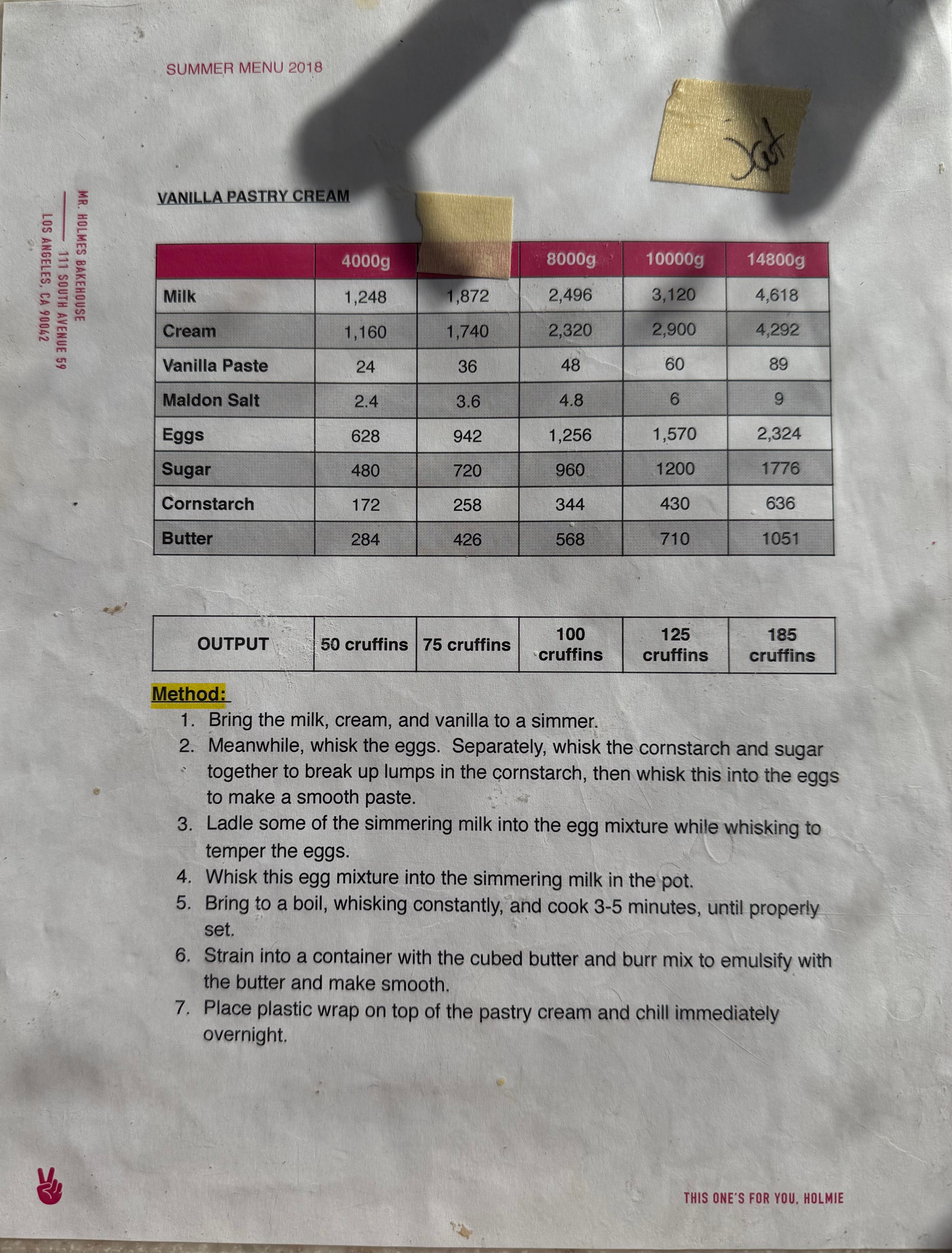
Often times though, as new recipes hit our books they would have less and less instruction. Especially for repeat fillings. If you know how to make vanilla pastry cream, making chocolate was as easy as pouring the vanilla pastry cream over chocolate and immersion blending. No need for a whole new set of instructions.
From here I don’t publish the recipe per se, rather the team is trained on new recipes/techniques- if applicable. But, when you’re working with professional bakers who know techniques, it’s as easy as saying “yeah, you make the pastry cream and pour it over chocolate” or” infuse the milk with x for 30 minutes, strain and make the recipe as you normally would”.
At this point the form of “publishing” is rolling new recipes and builds out for production.
And that my friends, is the flow of bringing a recipe from an idea to a published work. Let me know if you have any questions otherwise, I’ll TTYL <333

The method behind the madness revealed! 🙌
If you ever need someone to cross-test a recipe, I’d be down to volunteer 👀